
2.5 Model a Hybrid System
In this section, we will learn how to use Cyclone to verify a simple hybrid system. A hybrid system has both continuous and discrete dynamic behavior and it can both flow and jump. Typically, flow is described by some differential equations and jumps are modeled as a finite state machine.
To model a hybrid system, we will establish a model of physics and model of software. The physics model describes continuous dynamics and software model describes discrete dynamics.
Bouncing Ball
A classic example of a hybrid system is the bouncing ball (A system with impact). A ball is dropped from a predefined height. It then hits the ground (after a certain time), loses some energy and bounces back into the air and starts to fall again.
Its physical model can be described using the following differential equation:
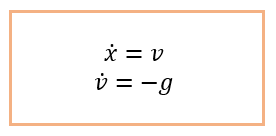
where v is our velocity (with respect to time t), x is the height, and g is the gravitational acceleration 9.81/ms2. As time (t) goes by, the ball moves closer (x) to the ground and eventually hits the ground when x=0. It then dissipates its energy and starts to bounce back. This behavior is modeled using the following equation:
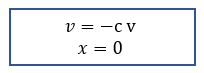
-c v accounts for the loss of energy due to the ball's deformation, where c ∈[0,1] is a constant.
The following graphs show the position of the ball and its velocity when time passes.
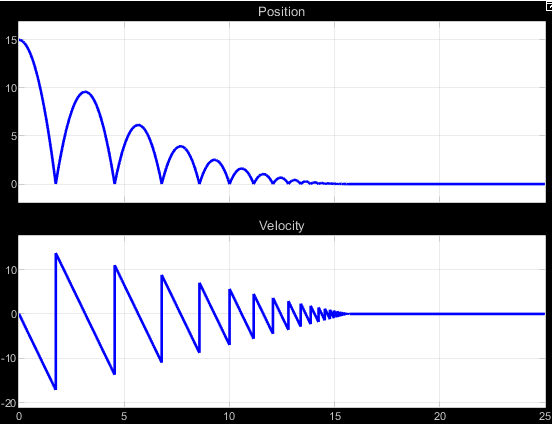
Now, We can use a finite state machine to describe discrete states of a bouncing ball. This state machine is as follows:
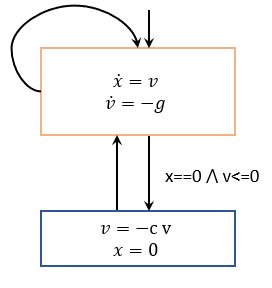
Further, the invariant here is no matter which state we are in our x (the height) should always stay positive (>=0). Hence, we have our Cyclone spec:
Next, we can just specify our goal section to ask Cyclone to check for specific traces of a counter-example.
Execution Result
Press 'run' to execute the code and see checking results.
Execution server didn't supply any information
URL: /projects/FYP24WH008/server