
1.4 Finding Hamiltonian Path
In previous Section, we learned some of the path operators and path conditions. With a combination of path operators and compound path conditions, we are able to solve many interesting problems from graph theory. For example, Hamiltonian path problem from Introduction . In this Section, we will show you how to write a Cyclone specification to solve this problem.
The graph from Chapter 0 is shown below:
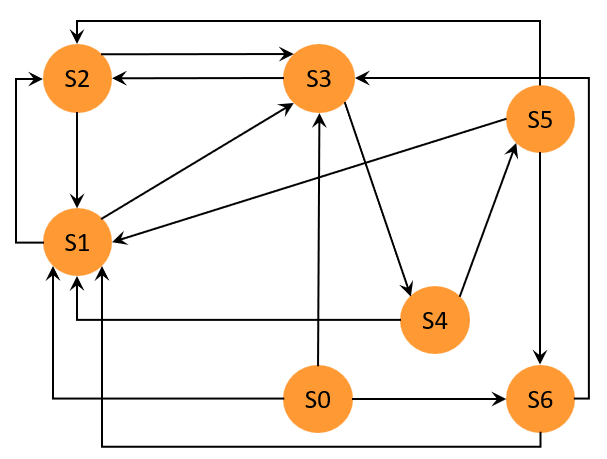
Remember the condition for finding a Hamiltonian path is that:
covers all the nodes of a graph exactly once
Since the condition says that first we need to cover all the nodes, we know we have a total of 7 nodes ( S0 - S6 ) in our graph. Therefore, a valid Hamiltonian path for this graph must have a length of 6 . The length of a path is defined by the number of edges.
Next, we need to cover each of node exactly once. We can easily use ^{i..j} path operator to construct a path condition for each node. Finally, we do not know which node this path will reach, but what we know is it eventually will reach any of these 7 nodes (except for our starting node). So we can specify these nodes in our reach statement.
Say we define node S0 as a starting point. Hence, we now can define our goal of finding Hamiltonian path for the graph above as follows:
The full specification for this problem is shown below:
Compile this specification, and Cyclone successfully finds a Hamiltonian path for this graph:
S0->S6->S3->S4->S5->S2->S1
1.4.1 Practice.
Can you use Cyclone to find all possible Hamiltonian paths in this graph?
Can you use Cyclone to find all possible Hamiltonian cycles in this graph?
A Hamiltonian cycle is a Hamiltonian path that starts and ends with the same node.
Execution Result
Press 'run' to execute the code and see checking results.
Execution server didn't supply any information
URL: /projects/FYP24WH008/server